From AI ambition to visible care: what Manchester taught us
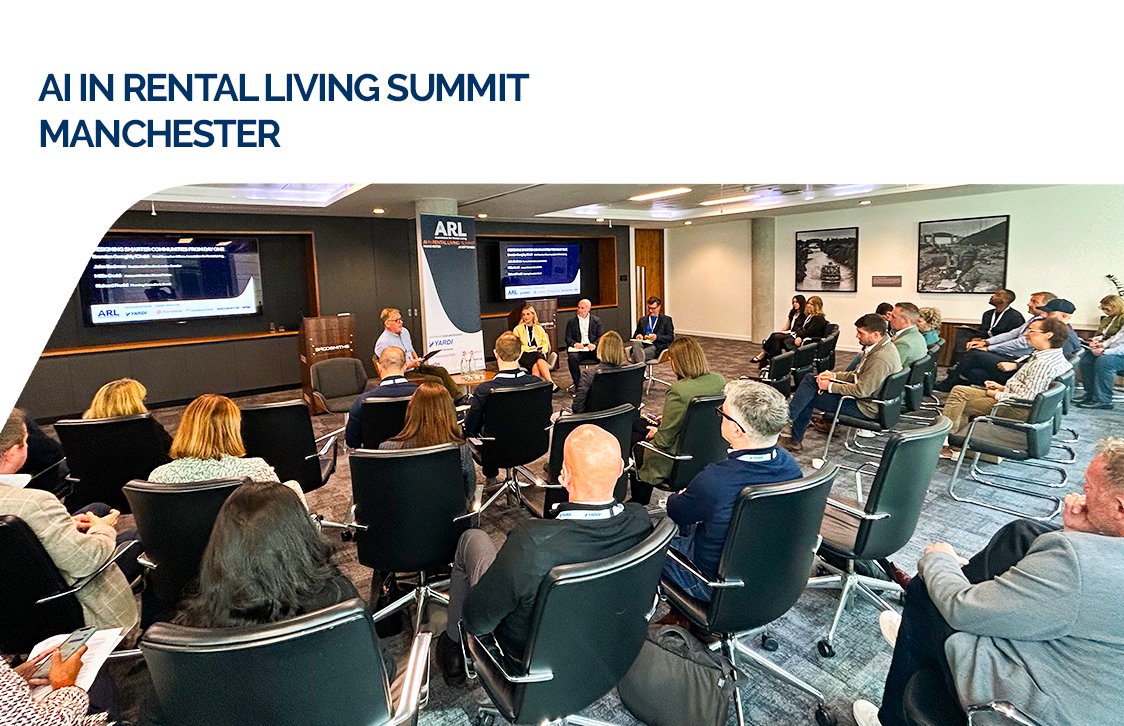
There was a core phrase echoing from session to session during the ARL’s AI in Rental Living Summit this week: “invisible reliability, visible care”.
Credit goes to opening keynote speaker Antony Slumbers for coining the phrase during an energising presentation, which came to encapsulate discussions during the day. AI capability is accelerating while costs are falling, he argued, so a leisurely three-to-seven-year transition is unlikely to be available. At the same time, regulation is changing the context in which technology is deployed. For rental living businesses, evidence, governance and accountability must sit alongside innovation.
His most memorable conclusion was also the most optimistic. The opportunity is not simply to automate. It is to make reliable processes disappear into the background, freeing people to provide the visible care that turns a building into a community.
With some speakers at the very start of their AI journey (with constructive discussion about what a comprehensive scoping exercise looks like across a complex organisation), to some who have built, scaled and won awards for their LLMs, agents and technical products, delegates really benefited from a range of views and, in several cases, robust challenge between panels and the audience.
This was not a room dazzled by technology for its own sake. It was a room asking what AI is actually for.
Start with the problem
ARL Chief Executive Brendan Geraghty opened with a grounded challenge: AI is already embedded across rental living; the task now is to understand where it is being used and shape it so that services improve while increasing – not sacrificing – resident trust.
His message was simple: start with the problem, not the technology. More tools do not automatically create better outcomes. Focused projects, supported by good data, proportionate safeguards, informed human oversight and clear accountability, do.
Humans remain firmly in the loop
That idea resurfaced throughout the day. In Delivering Smarter Investments, the panel imagined organisations adding hundreds – or even thousands – of virtual employee agents to complete specific, measurable tasks. Crucially, the discussion was not about removing existing teams, but about giving them new capacity.
In Making the Most of the Lease-Up Journey, speakers explored where automation can remove friction and where human judgement remains essential. One finding cut through the noise: after extensive resident research, a panellist reported that 70% of residents wanted simplicity. ‘All the bells and whistles’ are no substitute for something that works.
The Delivering Operational Excellence Through AI panel was equally candid. Successful adoption takes time, money and effort. Error rates and hallucinations are real, and not every AI tool is right for every job. Only human people can bring the contextual understanding needed to challenge an answer that looks convincing but is wrong.
As one speaker put it, AI should ensure that resident-facing teams have more time to spend with residents and to build the powerful communities for which the sector is known.
Get the foundations right
Before buying the engine, fix the plumbing. Siloed legacy systems deny AI the context it needs, and automation cannot rescue a broken workflow. Several speakers urged businesses to simplify processes first, identify a tightly defined need and then choose the technology.
Legal and compliance discussions brought the same point into sharp relief. One useful analogy was to treat an LLM like a new paralegal: potentially valuable, but always requiring supervision. Junior employees still need to understand how work is done and why, so they can challenge an AI interpretation quickly and effectively. This was another idea that resurfaced during the day, which is that the ability to “spot a lemon” in an LLM’s analysis remained the preserve of those with experience. Geraghty pointed out that this is the first time in the history of technology adoption that older users may be thriving more than younger ones.
Accountability cannot be delegated to an algorithm. That is especially important when decisions could affect a resident’s home or finances.
A Manchester perspective
Manchester was more than a backdrop. As one of the UK’s most mature Build to Rent markets, it has helped pioneer operational models, technologies and partnerships now influencing the wider rental living sector.
In Why Manchester Leads the UK’s Build to Rent Revolution, chaired by Yardi’s Chloe Sachikonye, the conversation turned to co-living and the importance of designing for working, networking and collaboration from the outset. In some schemes, operators are even reducing the number of residential units to create better communal space. It was a reminder that the best innovation is not always the most technical. Sometimes it is a better understanding of how people want to live.
From theory to action
Marcel Plummer, CTO at ItBox closed the day with a practical demonstration of how to build a ‘company brain’. His warning was that unstructured, chat-by-chat AI creates new silos: answers are invented afresh, knowledge is not updated and learning is not shared.
A useful shared knowledge system captures more than policies and organisation charts. It records why decisions were made, who knows what and what the team learned last time. His practical starting point was reassuringly small: one workspace, one meeting transcript and one question – while keeping resident personal data firmly outside the system.
Progress with safeguards
Equity, diversity and inclusion provided a final thread through the programme. AI carries the biases present in its training data and in the choices made by its designers. It may assist with screening or analysis, but it must not be allowed to automate discrimination. Human oversight, transparency and a culture prepared to question outputs are non-negotiable.
By the close, the narrative was clear. AI is moving quickly, but the sector does not need to chase every new tool. It needs to solve real problems, organise its knowledge, strengthen its governance and keep people in the loop.
Do that well and the technology can become almost invisible – quietly making services faster, simpler and more dependable – while giving our people more time for the thing residents notice most: visible care.
Such great content, so many fascinating conversations and to top it all off, the weather was kind! Manchester in the sunshine is – hands down – one of the most beautiful cities in the world. Our thanks go to headline sponsor Yardi; to our hosts, Shoosmiths, for looking after everyone so well; to event sponsors Homebox, Inventory Hive and WTW; and to exhibitors No Letting Go, ARK and PropCo.